July 2026: Market Report


Heatwaves, volatile energy prices and continued transport disruption have made July 2026 another challenging month for service providers, despite signs that headline inflation is beginning to ease.
Key Food & Beverage Movements
Extreme weather conditions across Europe have created real challenges for fresh produce growers. Prolonged heat and limited rainfall have constrained crop quality and availability across several fruit and vegetable categories.
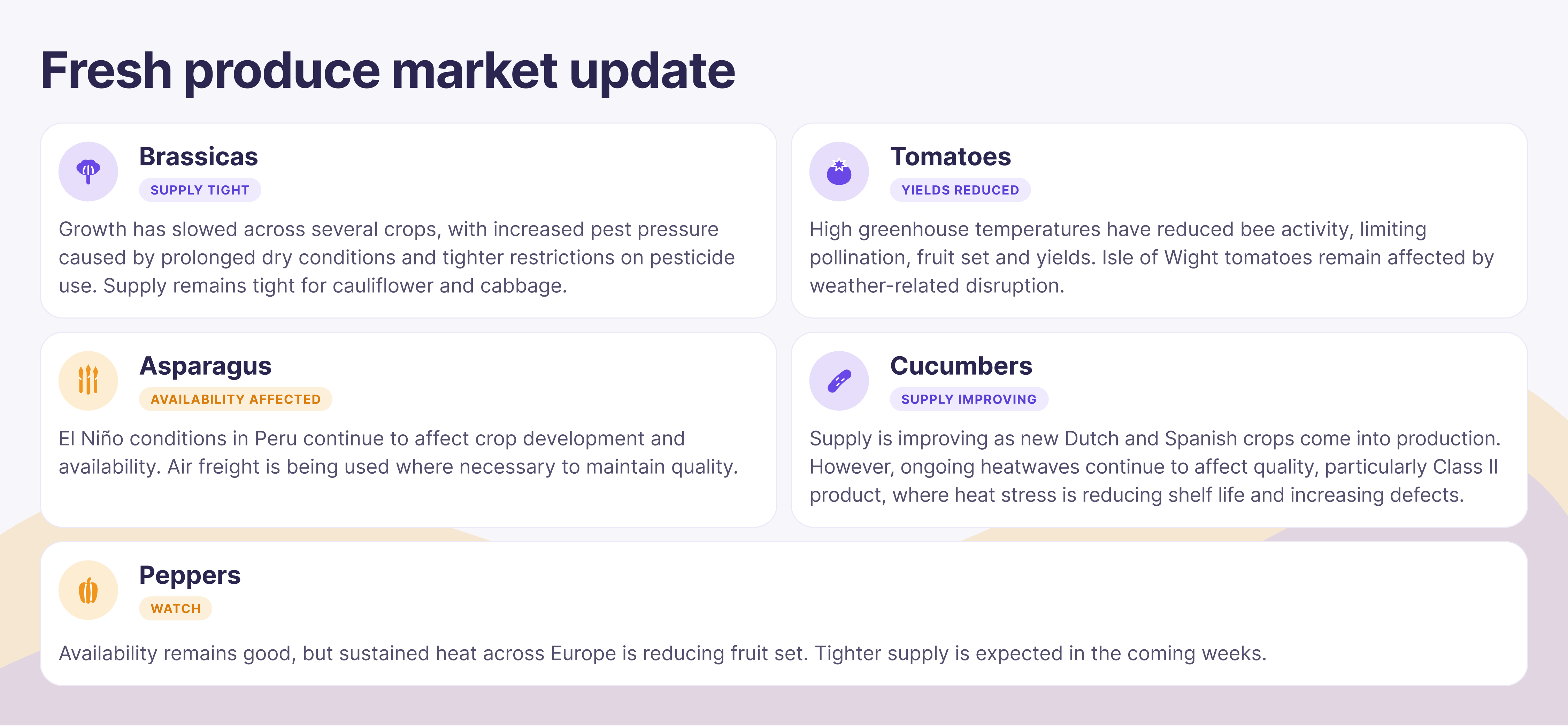
With that said, seasonal opportunities remain across British berries, carrots, leeks, new potatoes, herbs, edible flowers and imported stone fruit including peaches and nectarines.
Recent heatwaves are also affecting dairy production. AHDB estimates GB milk production is already down by 18.5 million litres this season. If conditions continue, reduced supply is likely to place further upward pressure on milk prices. Spot milk prices have already strengthened to 38–48ppl, well above Defra's average farmgate milk price of 34.2ppl.
Professor Pete Falloon, the Met Office's Science Lead for Food Security, believes greater action is needed to mitigate the effects of increasingly frequent extreme weather events. This requires a move towards more regenerative approaches, improved flood management, greater water storage, and the use of crop varieties that are more heat- or drought-tolerant.
Overarching Market Pressures
Monthly producer input prices fell 2.0% in June, the first decline since January 2026. However, they remain 7.3% higher than this time last year. The largest contribution came from crude oil, with prices rising 42.3% over the past year. Although oil prices fell sharply during June (down 20.8% month-on-month), they remain much higher than a year ago.
This is reflected in services producer prices, which rose 4.3% year-on-year, up from 3.2% in Q1, and transportation and storage services, which increased 8.9% year-on-year.
Falling petrol and diesel prices over the past month were one of the biggest reasons consumer inflation eased in June, with CPI falling to 2.6%, down from 2.8% in May.
Andrew Bailey, Governor of the Bank of England, said: "That is higher than it would have been if this conflict had not broken out. I think we'd have been around the 2.0% target otherwise. We've seen energy prices at a higher level, and we've also seen them be volatile depending on exactly what's going on in the conflict."
While he said there had been less pass-through into consumer prices than expected, he warned that "it's still early days with the conflict in the Middle East, so we will need to watch it very carefully."
Dr Liliana Danila, Chief Economist at the Food and Drink Federation (FDF), shared a similar sentiment regarding food inflation, which fell to 1.7%, down from 2.2% the previous month.
She explained that, following the Ukraine energy crisis, many food and drink manufacturers now secure energy and key commodity prices much further in advance — typically 12 to 18 months, and in some cases up to two years — with more than half of their energy requirements covered by long-term agreements.
As a result, the FDF continues to anticipate food price inflation rising later this year, although it expects the increase to be lower, occur later, and plateau for longer than during the previous inflationary cycle.
Outlook and Opportunities
The Government's recent announcement of a further 20% business rates discount for eligible pubs has provided some optimism for parts of the sector, although many hotels, restaurants, schools and care providers continue to look for wider support. Until then, focusing on the costs that can be influenced remains one of the most effective ways to protect margins.
Temporary charges introduced during periods of disruption often remain in contracts long after the original cost pressures have eased. Fuel surcharges, minimum order values, delivery frequencies and other additional fees are easy to overlook, making them well worth revisiting. Regularly reviewing spend across food, beverages, laundry, utilities, consumables and merchant services can also help offset some of these increases.
Cost savings are only one side of the equation. Identifying new income streams can be just as important. Restaurant delivery revenue increased 3.3% year-on-year in June, marking its third-best performance since late 2024. For hotels and restaurants, this highlights a chance to capture more in-house demand through takeaway or room service offerings, rather than losing that spend to third-party providers.
If you'd like to discuss the market developments covered in this report, or review where your organisation could make savings, book a call with our team.
AHDB (2026). Recent Heatwaves Impact GB Milk Production
Bank of England (2026). Interest Rates and Bank Rate
BBC (2026). 20% Business Rate Cut for English Pubs
Brakes (2026). Crop Reports: July
Food and Drink Federation (2026). FDF Food Inflation Statement
NIQ (2026). Restaurants’ At-Home Sales Grow 3.3%
Office for National Statistics (2026). Consumer Price Inflation: June
Office for National Statistics (2026). Producer Price Inflation: June
Oliver Kay (2026). Summer Crop Report
The Guardian (2026). Farmers Say the Climate Crisis Is Devastating Crops
.png)
.png)
.png)
.png)