How to make supplier rebates work for you
Are you paying full price for products you could be getting money back on? If you're not making use of supplier rebates, you might be.
But what exactly are they, and how do they work?
Put simply, a rebate is an arrangement where a supplier agrees to return a portion of what a customer spends if they meet specified purchasing criteria within an agreed period.
A rebate could be based on:
- Spend – the total value of purchases you make with a supplier;
- Volume – purchasing a specified number of cases or units; or
- Growth – increasing the amount of business you place with a supplier compared with a previous period.
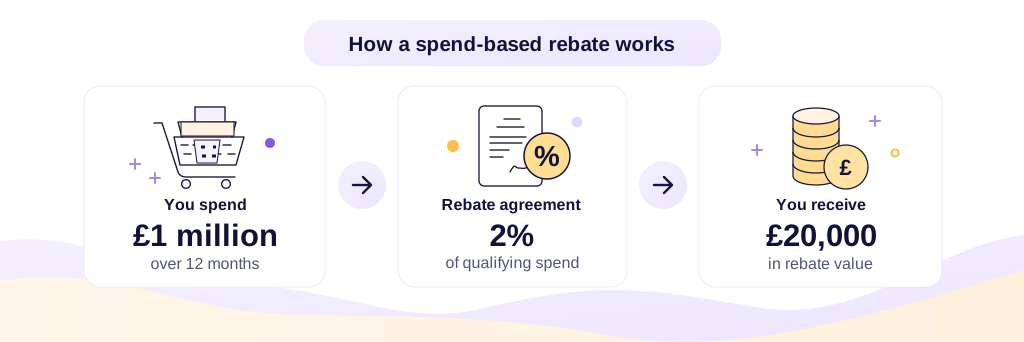
Some rebates are tiered, meaning the percentage you receive increases when your purchasing reaches certain thresholds. For example, you could receive 2% back when you spend £1 million over the agreed period, but 3% when you spend £1.2 million.
This may be paid upfront, retrospectively, or as a mix of the two. And it isn't always received as cash. Some agreements include contributions towards capital equipment — for instance, a foodservice supplier with a catering equipment division might provide an allotted amount to spend on new kitchen equipment.
But why would a supplier offer this? What's in it for them?
We spoke to our team about why these agreements aren't simply a case of suppliers giving money away — and what you need to know to make sure you're getting the maximum value from yours.
Why do suppliers offer rebates?
Suppliers use rebate agreements partly because they give customers a reason to commit more of their purchasing to them. Say a customer currently gives a supplier £1 million of business but spends another £400,000 elsewhere.
The supplier might offer a higher rebate to encourage them to move more of that spend across. That additional business can be commercially attractive even if the supplier is offering a slightly tighter margin. One reason is what we call ‘drop value’.
If a supplier is already delivering to a customer, increasing the value of that delivery from £500 to £700 doesn't necessarily increase the cost of servicing the account by the same amount. So, while the margin might be slightly tighter, the supplier can still make more overall by winning a greater share of the customer's spend.
These agreements can also give suppliers greater certainty. Because they usually require the customer to meet certain conditions — such as a minimum level of spend and, potentially, agreed delivery patterns — suppliers have a clearer idea of the business they're likely to receive and can better forecast the revenue they expect to make.
Having contracted customers can also give suppliers greater buying power themselves. They can go back to manufacturers and brands with a known amount of contracted business and negotiate better deals and terms.
.svg)
A rebate can provide a significant cash injection for a business, but what should you consider before entering an agreement?
Don't enter a rebate agreement simply because you've always had one. There has to be a reason for it and a clear idea of what you want it to achieve. For example, rebates paid centrally can help offset the cost of a head-office function, while upfront cash can provide valuable cash-flow support when a business needs it.
Once you know what you need, be consistent in what you ask suppliers for. If you want £50,000 upfront and a 2% retrospective rebate, ask each competing supplier to quote against that same requirement. Otherwise, one might offer £50,000 plus 2%, while another offers £100,000 plus 1%, and suddenly you're trying to compare two very different commercial arrangements.
And don't automatically be tempted by the bigger number. If you've established that the business needs £50,000 upfront, be clear on why before accepting an offer of £100,000.
That's particularly important with upfront cash because it can leave you more heavily committed to the supplier. If the supplier later increases its prices or service levels deteriorate, you might decide you want to leave. But if you haven't checked the terms, you could find that exiting the agreement comes with significant costs.
So always understand the exit strategy before entering an arrangement, rather than discovering it when you want to leave. What happens if prices increase, service levels decline or the agreement simply doesn't deliver what you expected? There may be different terms you can negotiate, but you need to ask those questions at the outset.
Does the supplier offering the highest rebate necessarily offer the best deal, or what else should businesses be looking at?
No. A higher rebate can look attractive, but it needs to be considered alongside the wider commercial offer. What are you actually paying for the products? What are the minimum order values? Are there delivery or invoice charges that could add to your overall costs? Can the supplier deliver on the days you need and within the required time slots?
A good price and a generous rebate aren't much use if the service doesn't work operationally for your business. Payment terms are important too. One supplier might offer stronger pricing but require payment within 15 days, while another gives you more flexibility.
None of these factors should be looked at in isolation — the headline rebate is only one part of the deal.
Where do you see businesses missing out on rebates they could be receiving?
One of the biggest issues is simply not knowing where you are against your rebate targets. Say your agreement gives you 2% back at £1 million of spend, but that increases to 3% at £1.2 million. You could finish the year at £1.195 million — just £5,000 short of the next tier — because nobody was tracking it.
.svg)
If £1.2 million is your target, keep an eye on your monthly spend. You'd expect to be spending around £100,000 a month. If you're consistently below that, you can see early on that you're falling behind rather than discovering it at the end of the year.
The same applies across a group. You might have five hotels, with four buying through the agreed supplier while one is purchasing elsewhere. That one site's purchasing could affect whether the entire group reaches its target and receives the rebate.
The key is not to sign the agreement and then forget about it. Rebate management needs to be an ongoing process and part of a cohesive procurement strategy across the business.
Is it possible to end up spending more because of a rebate agreement, and how do you know whether you're actually getting good value?
Absolutely. You shouldn't spend more simply for the sake of hitting a rebate target. But there are situations where increasing your spend can make commercial sense. If you're £5,000 short of your target and buying £5,000 of stock you genuinely need would unlock a £30,000 rebate, for example, bringing that purchase forward could be worthwhile.
The important thing is knowing what you're paying in the first place. If a supplier is giving you 2% back but you're paying more than the market price for the products, how much value are you really getting from that rebate? At particularly high rebate levels, there's also the risk that some of that cost is being absorbed into the underlying pricing.
That's where benchmarking comes in. We continually benchmark market pricing for our clients, so they can see whether they're paying a competitive price as well as what they're receiving back through the rebate. It's the overall value of the arrangement that matters, not simply the amount you get back.
[[cta|See how Amaze Hotels secured £165,000+ in retrospective beverage payments|/case-studies/profitable-growth-for-amaze-hotels-group]]
If you had to highlight just three things every business should consider when managing a rebate agreement, what would they be?
I'd bring it back to three questions. Why do you want the rebate? How are you going to track and manage it? And if the agreement doesn't work out as expected, how are you going to get out of it?
Get those things right, and you're in a much stronger position to make the rebate work for your business.
If you need support reviewing or managing your supplier agreements, get in touch to book a call with our team.
.png)
.png)
.png)






.png)